 Trang Chủ


The Governor of the State Bank of Vietnam (SBV) shall stipulate the deposit insurance premium rates and set either a flat rate or differential rate system tailored to the characteristics of the credit institution system in different periods.
National Assembly Deputy Thai Quynh Mai Dung (Phu Tho) emphasized that premium collection is the primary source of revenue for the operational reserve fund, which is used for deposit insurance reimbursement and participation in resolving weak credit institutions.
Currently, Clause 1, Article 19 authorizes the SBV Governor to stipulate deposit insurance premium rates and set either a flat rate or differential rate system tailored to the characteristics of Vietnam’s credit institution system in different periods. National Assembly Deputy Thai Quynh Mai Dung agreed with this delegation of authority; however, she recommended that a clear roadmap be established for the implementation of a differential deposit insurance premium system.
The SBV is the State authority responsible for examining, supervising the credit institution system and overseeing deposit insurance operations. Therefore, the SBV Governor shall stipulate the collection of deposit insurance premiums and set either a flat or differential rate system in accordance with practical conditions.
Agreeing with the delegation of authority to the SBV Governor to stipulate deposit insurance premiums, National Assembly Deputy Thai Thi An Chung (Nghe An) noted that both flat and differential premium systems have their own advantages and disadvantages. While the differential premium system encourages credit institutions to improve their governance capacity and operate prudently and safely to pay lower rates, it also has the drawback that lower-rated or financially weaker credit institutions must pay higher premiums. As a result, this system may place additional burdens on lower-rated institutions.
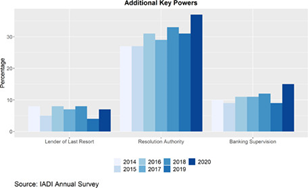
International practices show that the number of countries applying flat or differential premiums is fairly balanced. According to the 2024 Annual Survey by the International Association of Deposit Insurers (IADI) covering 110 deposit insurers, in response to questions regarding deposit insurance premiums, 50 institutions (46%) applied flat premiums, 52 institutions (47%) applied differential premiums, and 8 institutions (7%) applied both flat and differential premiums.
This balance reflects the reality that other countries carefully consider the advantages and disadvantages of each premium system before deciding which to implement domestically. Therefore, National Assembly Deputy Thai Thi An Chung believes that it is appropriate for the SBV Governor to stipulate either a flat premium or differential premiums tailored to the characteristics of the credit institution system in different periods.
However, in the event that the SBV decides to apply risk-based differential premiums, the National Assembly Deputy proposed adding to the draft Law provisions on safeguarding the confidentiality of rating information and premium levels, in order to prevent the risk of unfair competition or a scenario in which depositors withdraw their funds from lower-rated institutions and move them to higher-rated ones.
Clarifying this matter, SBV Governor Nguyen Thi Hong emphasized that the draft Law on Deposit Insurance (amended) provides for the application of both flat and differential premium systems, each with its own advantages, disadvantages, and implementation conditions.
At present, Vietnam applies a flat premium system; when the necessary conditions are met, differential deposit insurance premiums may be introduced to encourage credit institutions to improve their performance and thereby reduce deposit insurance costs.
However, in line with the legislative direction that the Law should stipulate only general and principle-based matters, technical and detailed provisions will be assigned to the Government and relevant ministries for guidance, ensuring flexibility and consistency with practical conditions.
An increase in deposit insurance premium rates shall only be permitted in exceptional circumstances
Another key issue raised by National Assembly delegates during the plenary discussion was the draft Law’s new provision allowing the Deposit Insurance of Vietnam (DIV) to obtain special loans from the SBV in cases its operational reserve fund is insufficient to reimburse depositors.
Several delegates noted that introducing a special loan mechanism is a reasonable and essential financial measure, in line with international practice and ensuring coherence with the Law on Credit Institutions. This mechanism enhances immediate liquidity and protects depositors’ rights, while also preventing contagion risks and domino effects within the financial system.
To ensure consistency and clarity, National Assembly delegates proposed that the drafting agency further review and set out clear and consistent criteria governing the circumstances under which the DIV may obtain special loans from the SBV.
Clause 2, Article 38 of the draft Law stipulates that the DIV must develop a plan to increase deposit insurance premium rates in order to offset any special loans obtained from the SBV. Delegatess agreed with this provision, stating that when the DIV obtains special loans from the SBV, requiring sound credit institutions to contribute additional premiums is necessary to uphold the principle of using market-based resources to address market-related issues. This approach also helps prevent bank runs at sound institutions and maintains depositor confidence.
However, from another perspective, National Assembly Deputy Nguyen Thanh Nam (Phu Tho) noted that increasing deposit insurance premiums would directly affect the operations of insured institutions by raising operating costs and reducing profitability, thereby requiring adjustments in their financial and business plans. If such increases are not controlled or applied over a long period, they could negatively impact the operations and competitiveness of the entire system and create financial pressure on insured institutions.
Therefore, to ensure these mechanisms are implemented effectively, transparently, and in accordance with market discipline, National Assembly Deputy Nguyen Thanh Nam proposed supplementing and clarifying several provisions of the Law that are principled, directive, and binding. Accordingly, with respect to the premium rate-increase plan under Clause 2, Article 38, the criteria for determining the rate increase, the duration of its application, the conditions for implementation, and the requirements for public disclosure should be clearly defined in order to ensure transparency and enable insured institutions to develop long-term business plans.
In addition, under Clause 3, Article 38 of the draft Law, the responsibilities of the SBV Governor in guiding the DIV’s access to special loans must be clearly specified. Such guidance should set out specific financial thresholds before allowing a request for a special loan, including only after deploying all other resources as prescribed; the maximum allowable deposit insurance premium increase to offset the special loan; limits on the duration of the premium increase; and the maximum repayment schedule for the special loan. It should also affirm that the special loan must be used solely for reimbursement, not for any form of market intervention.
“The enactment of legislation and the delegation of authority must be aligned with the establishment of a strong and effective framework, by incorporating and clearly defining principled, directive and binding provisions within the Law. This will create a robust legal framework ensuring that special loans would serve as a stable, systemic, and effective instrument rather than an easy financial escape, thereby achieving the dual objective of protecting depositors while maintaining market discipline and ensuring the safety of the entire credit system”, National Assembly Deputy Nguyen Thanh Nam emphasized.
Regarding this issue, SBV Governor Nguyen Thi Hong affirmed that premium increases would be applied only under exceptional circumstances, specifically when the operational reserve fund is insufficient and the DIV must obtain a special loan from the SBV to reimburse depositors. This measure aims to prevent contagion risks and protect depositors’ interests.
Research and International Cooperation Department (translation)