 Trang Chủ


. The Reserve Bank of India also promoted a public limited company in 1971, named the Credit Guarantee Corporation of India Ltd. (CGCI) to operationalize the Credit Guarantee Scheme of the Government of India, which provided guarantee cover to the loans and advances granted by the credit institutions to small and needy borrowers covered under the priority sector.
Coverage of Entities
All commercial banks including the branches of foreign banks functioning in India, Local Area Banks (LABs), Regional Rural Banks (RRBs), Small Finance Banks (SFBs), Payment Banks (PBs) and co-operative banks are covered under the DI Scheme. The number of insured banks as on Dec 31, 2017 stood at 2,110 comprising 159 Commercial banks (including 56 RRBs, 3 LABs, 5 payment banks and 9 small finance banks) and 1,951 Co-operative banks (33 State Co-operative Banks, 364 District Central Co-operative Banks and 1,554 Urban Co-operative Banks). Small and medium sized banks constitute the majority of insured banks in India comprising LABs, RRBs, SFBs, PBs and Co-operative banks.
Insurance Coverage Limit
The current limit of DI is USD 1538 (Rs.0.1 million). Total number of insured accounts as on March 31, 2017 stood at 1737.2 million covering around 92% of the total accounts, amounting to USD 470 billion, covering approximately 30% of the assessable deposits. These are well within the IADI guidance norms of 80 % of accounts and 20-30 % of insured deposits, respectively.
Premium
The Corporation collects insurance premium from insured banks semi-annually, within two months from the beginning of each financial half year, based on their deposits as at the end of previous half year. Premium is computed on the basis of the insured bank’s assessable deposits and is borne by the banks themselves and is not passed on to the depositors. Currently, the premium is charged at 0.1 per cent per annum per Rs.100 of the assessable deposits held by the insured banks as at the end of the previous half year.
Deposit Insurance Fund
The Deposit Insurance Fund (DIF) is sourced primarily from the premium paid by the insured banks. It also includes the coupon income received from the Corp’s investments in the Central Government securities. This fund is used for settlement of claims of depositors of banks taken into liquidation / reconstruction / amalgamation etc. The size of DIF stood at USD 108 billion as on March 31, 2017. In addition Credit Guarantee Fund (CGF) and General Fund (GF) are also maintained by the Corp. Currently there is no claim liability in respect of the CGF. The General Fund is utilised for meeting the establishment and administrative expenses of the Corporation. As on March 31, 2017, CGF and GF stood at USD 0.08 billion and USD 0.07 billion respectively. The surplus balances in all the three Funds are invested in Central Government securities.
Claim Settlement
DICGC reimburses the depositors of failed banks. In the event of the winding up or liquidation of an insured bank, every depositor is entitled to payment of an amount equal to (but at maximum of 100,000 rupees) the deposits held by him at all the branches of that bank put together as on the date of cancellation of registration subject to set-off of his/her dues to the bank. Under the provisions of the DICGC Act, the liquidator of an insured bank which has been wound up or taken into liquidation, has to submit to the Corp a list showing separately the amount of the deposit in respect of each depositor and the amount of set off, in such a manner as may be specified by the Corp within three months of his assuming charge as liquidator. The Corporation has to settle the claims within two months from the date of receipt of list of depositors of the failed bank from the liquidator.
Recovery of Settled Claims
As per the provisions of the DICGC Act, the liquidator or the insured bank or the transferee bank is required to repay to the Corporation the amount disbursed by the Corporation out of the amounts realised from the assets of the failed bank and other amounts in hand after netting off the expenses incurred.
Governance
The general superintendence, direction and the management of the affairs and business of the Corp are vested in the Board of Directors (BoD). The BoD comprises of the Chairperson, who is the Deputy Governor of RBI, the Executive Director of the RBI, directors nominated by the Government of India and Independent directors. General Regulations of Corp prescribe that ‘an Independent Director’ of an insured bank cannot become a ‘Director on the Board of DICGC’ to address the conflict of interest. DICGC Act prescribes holding quarterly meetings of its BoD to oversee its working. It submits the annual accounts along with its working every year to Parliament as a part of statutory requirement, which are published every year.
Other Important Activities
The Corporation disseminates information about DI to the public through insured banks, website, booklet on guidelines on DI and brochures. The Corporation conducts workshops for liquidators for expeditious settlement of claims, particularly for depositors of small sized banks. The Corporation participates in the coordination committee meetings of the regulatory and supervisory departments to resolve the issues relating to DI. The Corporation is in the process of revamping its IT systems for improving the operational efficiency.
Resolution
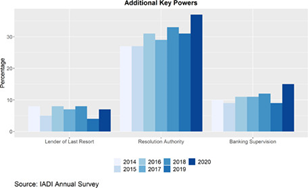
At present, DICGC functions as a pay box entity i.e. reimbursing the depositors of failed banks. As per the current framework, resolution functions of financial entities are spread across different statutes. In order to bring the resolution of all financial entities under one single authority and also to address the gaps in current resolution architecture as per FSB Key Attributes, a draft ‘Financial Resolution and Deposit Insurance Bill, 2017’ was introduced in August 2017 for setting up of a Resolution Corporation (RC). The Bill envisages enlarged mandate for RC in terms of strict timelines, restoration and resolution plans, separate legal framework, oversight function, bridge institution, bail-in and liquidation besides the tasks currently handled by DICGC.